Capital, Interest & Rent by Frank A. Fetter
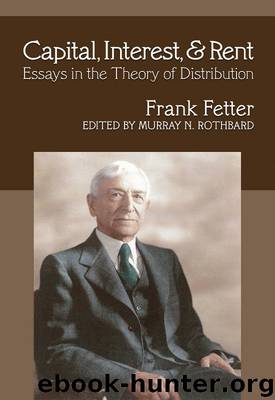
Author:Frank A. Fetter [Frank A. Fetter]
Language: eng
Format: epub
ISBN: 978-1-61016-015-5
Publisher: Sheed Andrews and McMeel, Inc.
Published: 1977-11-06T16:00:00+00:00
_________________
Reprinted from American Economic Association, Papers and Proceedings of the Sixteenth Annual Meeting 5 (February 1904). The discussants of Fetter’s paper included Thomas N. Carver, Jacob H. Hollander, Charles W. MacFarlane, Lindley M. Keasbey, W. G. Langworthy Taylor, Richard T. Ely, James Edward LeRossignol, Franklin H. Giddings, and Winthrop M. Daniels (see ibid., pp. 199-227). Fetter’s reply to their criticisms is reprinted here.
NOTES
The argument in this paper, forced into excessive brevity at many points, should be interpreted in conection with other essays by the writer, published from time to time in the past three years. Arranged, as nearly as their special nature permits, in a logical series, they are as follows:
1. The next decade of economic theory, Publ, of Amer. Econ. Asso., 3d ser., vol. 2, no. I, p. 236-246 (read Dec. 29, 1900). Points out the relative and temporary nature of the old concepts of rent and of capital, and suggests the general direction that may be taken in their restatement [see above, pp. 74-83].
2. The passing of the old rent concept, Quar. Jour. Econ., vol. 15, pp. 416-455 (May, 1901). A detailed criticism, purely negative, of Marshall’s doctrine of quasi-rent, as typical of the prevailing unsettled condition of thought on this subject [see pp. 318-354].
3. Recent discussion of the capital concept, Quar. Jour. Econ., vol. 15, pp. 1-45 (Nov., 1900). A review of the contributions of Clark, Irving Fisher and Böhm-Bawerk to this subject, criticizing especially the last named in his distinction between social and individual capital, between consumption and production goods, between natural and produced agents; concluding with a positive statement of a concept of capital, as distinguished from wealth [see above, pp. 33-73].
4. The “roundabout process” in the interest theory, Quar. Jour. Econ., vol. 17, pp. 163-180 (Nov. 1902). A criticism of Böhm-Bawerk’s “Positive theory,” showing that his retention of a defective capital concept is the cause of his retaining (inconsistently) a productivity theory of interest; concluding with a suggestion of the true relation of productivity to a theory of interest. The present paper unites, and develops somewhat, the various arguments in this series of articles [see above, pp. 172-191].
1. A. S. Johnson, Rent in modern economic theory, p. 19, Publ. Amer. Econ. Asso., 3d ser., vol. 3, no. 4. Probably most students would not consider this explanation a commonplace and would even deny that it truly states the principal cause of the distinction in question. The author quoted makes it the main thesis of his book that the difference between land rent and interest, though thus originally observed as a merely transitory historical fact, remains of permanent significance.
2. Zwei Bucher zur socialan Geschichte England’s, p. 160.
3. Note for example, Ricardo, 1817: “that portion of the produce of the earth, which is paid to the landlord,” etc.; F. A. Walker, 1887: “the remuneration received by the landowning class,” etc.; Marshall, 1890: “the income derived from the ownership of land,” etc.; Bullock, 1897: “the return that is secured by the owner,” etc.
4. This question is dealt with more fully in “The passing of the old rent concept,” especially pp.
Download
This site does not store any files on its server. We only index and link to content provided by other sites. Please contact the content providers to delete copyright contents if any and email us, we'll remove relevant links or contents immediately.
Waking Up in Heaven: A True Story of Brokenness, Heaven, and Life Again by McVea Crystal & Tresniowski Alex(37815)
Still Foolin’ ’Em by Billy Crystal(36363)
Cecilia; Or, Memoirs of an Heiress — Volume 1 by Fanny Burney(32563)
Cecilia; Or, Memoirs of an Heiress — Volume 2 by Fanny Burney(31962)
Cecilia; Or, Memoirs of an Heiress — Volume 3 by Fanny Burney(31945)
Fanny Burney by Claire Harman(26608)
Empire of the Sikhs by Patwant Singh(23090)
We're Going to Need More Wine by Gabrielle Union(19055)
Hans Sturm: A Soldier's Odyssey on the Eastern Front by Gordon Williamson(18596)
Plagued by Fire by Paul Hendrickson(17417)
Out of India by Michael Foss(16861)
All the Missing Girls by Megan Miranda(16053)
Cat's cradle by Kurt Vonnegut(15365)
Pimp by Iceberg Slim(14523)
For the Love of Europe by Rick Steves(14180)
Molly's Game by Molly Bloom(14149)
Bombshells: Glamour Girls of a Lifetime by Sullivan Steve(14082)
Leonardo da Vinci by Walter Isaacson(13342)
4 3 2 1: A Novel by Paul Auster(12405)
